Like some great god

The silver trumpets rang across the Dome:
The people knelt upon the ground with awe:
And borne upon the necks of men I saw,
Like some great God, the Holy Lord of Rome.
Priest-like, he wore a robe more white than foam,
And, king-like, swathed himself in royal red,
Three crowns of gold rose high upon his head:
In splendour and in light the Pope passed home.
My heart stole back across wide wastes of years
To One who wandered by a lonely sea,
And sought in vain for any place of rest:
'Foxes have holes, and every bird its nest.
I, only I, must wander wearily,
And bruise my feet, and drink wine salt with tears.'

This is ‘Easter Day,’ which Oscar Wilde wrote while on a visit to Rome in the last year of his life. Wilde had every reason to find himself at odds with splendid authority borne on the necks of men, and I like to be reminded that this puts him in company with Christ.

In the last week of Jesus’ short life, his conflict with the religious authorities - a conflict that began with his first acts of miraculous healing - escalates to the point where they have him lynched; their own glory so threatened by this footsore preacher that they render him up to the theatrical vengeance of Imperial Rome. 

Easter, as Wilde standing in St Peter’s Square suddenly saw, was a clash between homeless divinity and gilded authority. Between light and splendour. 
In those unwardened provinces

Adrienne Rich died this past week. She was a poet who seemed to start out conventional and end up up-ending just that. As the New Yorker put it, she and many other women trod the trimmed path in the 40s and 50s, only to find in the 60s and 70s that they wanted to tear up the grass. She was born in 1929, so in her 83 years she must have witnessed epochal change in the way women see and are seen, many times over. Her most famous poem, probably, is “Diving into the Wreck,” which became a kind of manifesto for a certain kind of feminism: “the wreck and not the story of the wreck; the thing itself and not the myth.” The underwater search for unaccommodated woman is a dark exercise; she comes, after all, to see “the damage.” There's little light here, if there's truth. I prefer the dazzling joy of this earlier, sweeter poem, “Holiday,” with its intentional forgetfulness of dark.  

Summer was another country, where the birds
Woke us at dawn among the dripping leaves
And lent to all our fetes their sweet approval.
The touch of air on flesh was lighter, keener,
The senses flourished like a laden tree
Whose every gesture finishes in a flower.
In those unwardened provinces we dined
From wicker baskets by a green canal,
Staining our lips with peach and nectarine,
Slapping at golden wasps. And when we kissed,
Tasting that sunlit juice, the landscape folded
Into our clasp, and not a breath recalled
The long walk back to winter, leagues away.

A green thought in a green shade

Since I spent much of yesterday in the garden, tending ripening tomatoes, pulling weeds from between thick clusters of rosemary and thyme, repotting a lavender, and generally messing about, I thought today of Andrew Marvell's gorgeous poem “The Garden.” It's one of a suite of garden or pastoral poems Marvell wrote, lusciously evocative and highly idealized. I don't mind a bit of idealism in these garden idylls. I'd rather bring the poem into the garden than the garden into the poem.

What wondrous life is this I lead;
Ripe apples drop about my head;
The luscious clusters of the vine
Upon my mouth do crush their wine;
The nectarine and curious peach
Into my hands themselves do reach;
Stumbling on melons as I pass,
Insnared with flowers, I fall on grass.
 

Meanwhile the mind, from pleasure less,
Withdraws into its happiness:
The mind, that ocean where each kind
Does straight its own resemblance find;
Yet it creates, transcending these,
Far other worlds, and other seas;
Annihilating all that's made
To a green thought in a green shade.

Here at the fountain's sliding foot,
Or at some fruit-tree's mossy root,
Casting the body's vest aside,
My soul into the boughs does glide:
There like a bird it sits and sings,
Then whets and combs its silver wings;
And, till prepared for longer flight,
Waves in its plumes the various light.

Such was that happy garden-state,
While man there walked without a mate:
After a place so pure and sweet,
What other help could yet be meet!
But 'twas beyond a mortal's share
To wander solitary there:
Two paradises 'twere in one
To live in Paradise alone.

This turbulent priest

I’m sad to hear that Rowan Williams is resigning. He’s not been everyone’s cup of tea as Archbishop, but he’s my kind of prelate. Thoughtful, humane, sonorous, and kindly. He could talk about biblical texts as though they had something to say about human experience, and about Dickens or Dostoevsky as though what they say about human experience has deep moral resonance. His contributions to public debates, unlike those of many other religious leaders, have been subtle and ruminative but nonetheless morally resolute. Moreover he has intervened reluctantly on questions of private morality, and unhesitatingly on questions of public morality. He has had far more to say about war, injustice, poverty, and oppression than about sex. Unfortunately, members of his flock have decided that sex is the defining moral issue of our time. So after ten years in a tough job, he’s going to the greener pastures of a Cambridge College. Many will say he’s better off back in his academic box, but I think he’s a great loss to public discourse and to a much wider communion than his own. They’ll say the Anglican communion is more deeply divided now than it was a decade ago, but who do they suppose could unite it? In a time when there seems less room for complexity, less oxygen for nuance and balance, his loss feels like a victory for the one-dimensioned over the many. As the darkness deepens, his going feels like one more light going out. 

Romance and the city

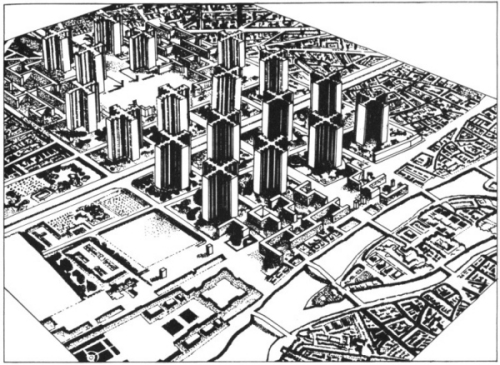
Thank God Corbusier wasn’t allowed to do this:

The larger point Elizabeth Farrelly made (last night at the Albert Hall) was that modernism has meant cities as objects rather than ‘containers for humans’. Modernist cities planned on Corbusian lines plant imposing objects and leave the spaces to fend for themselves, whereas the ideal city - ideal because green, creative, lovely, enchanting - uses the objects to shape the common spaces. The buildings are simply the wallpaper of streets and squares as inviting rooms for people to live in, not look at. I like this notion, but don’t see that it has to be quite as gendered as Farrelly makes it: towering as masculine, textured as feminine. Whatever might be argued about modernism and masculinity, you don’t have to see modernism’s remedies as feminine to think they’d make better cities. More interesting to me was the tension between planned spaces as livable and organic spaces as lovable. Planned space might tick all the boxes, but the plan’s no good if people don’t flow wantonly and naturally in and out of the space. The answer seems to be about the play of both in history: what Farrelly called a ‘dance’ of evolution and intervention across time. Maybe that’s why Canberra feels overplanned and undercooked. The dance is only just getting started. Maybe in two or three or five hundred years, Canberra will be closer to the enchanting ideal.